|
|
Boggle
|
Name:
|
Boggle |
|
| Company: |
Atari |
|
Model #:
|
N/A |
|
Programmer:
|
David Crane |
| Year: |
1978 |
|
Released?
|
No
|
|
Notes:
|
Based on the Parker
Brothers board game
|
In the early years of the 2600, Atari attempted to appeal to a
wide range of people by creating games from many different
genres. One of these genres was board games, which was
fertile ground for many beginning programmers. In addition
to Checkers, Backgammon, 3-D Tic Tac Toe, and Chess, it appears
that Atari was also toying around with releasing a game based on
the then best selling word game Boggle. Although a complex
word game may have seemed beyond the 2600's abilities,
programmer David Crane proved that it was indeed possible.
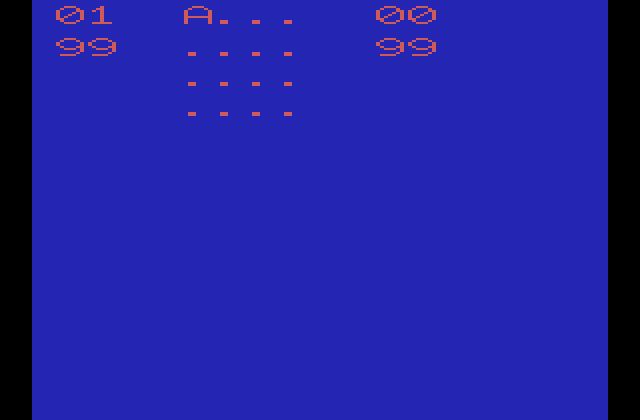
For those of you not familiar with Boggle, the rules are quite
simple. At the start of each game, a 4x4 grid of letters is
randomized by a player shaking a domed container of cubes with
letters on them. Then each player attempts to see how many
words they can make out of the letters that are displayed.
You can start a word from any tile on the board, and as long
as the next tile in the word is adjacent to that tile. You
can move forwards, backwards, or diagonally, but cannot use the
same tile twice in a word. You also cannot cross over the
edge of the board (for example, moving from the top of the board
to the bottom).
After each player has formed a list of words, the
first part of the game is over. Now players read off each
word on their list and after all the duplicates are discarded,
they vote on whether each word will be accepted or not. The
scoring in Boggle is based off the length of the word, three
letter words are worth 1 point, four letter words are worth 2
points, and so on. The player who scores the most points
wins. The loser may now throw the Boggle board at the
winner's head.
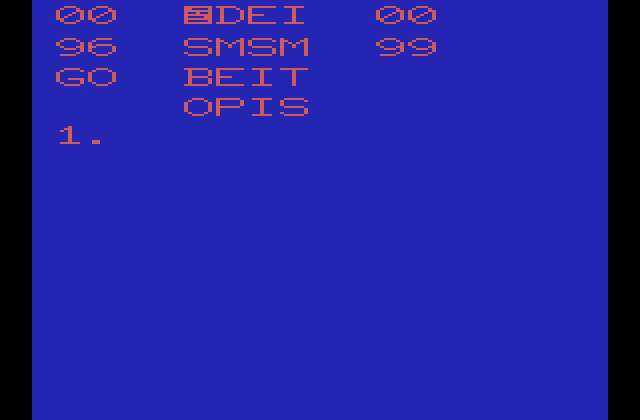
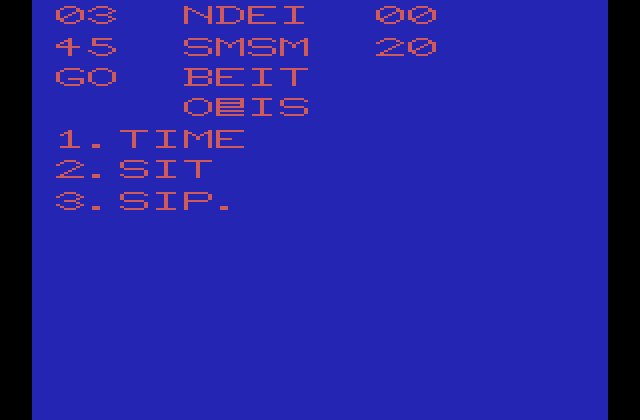
The 2600 does a fairly decent job at creating a
presentable game of Boggle. The letters are displayed using
the then popular Venetian Blinds technique, which allowed the 2600
to appear to display twice the normal amount of objects on a line
(see Video Chess for more details). However other than the
grid and letters, there really isn't much going on graphically
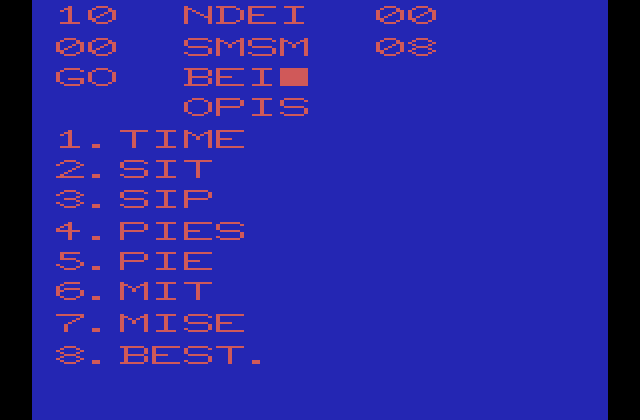
(which was normal for early 2600 games). Each player takes
turns selecting the letters they want to use to form the word
using the joystick, when the player is done they simply need to
press the fire button again (a dot will appear at the end of the
word). After which, the the other player will begin his turn
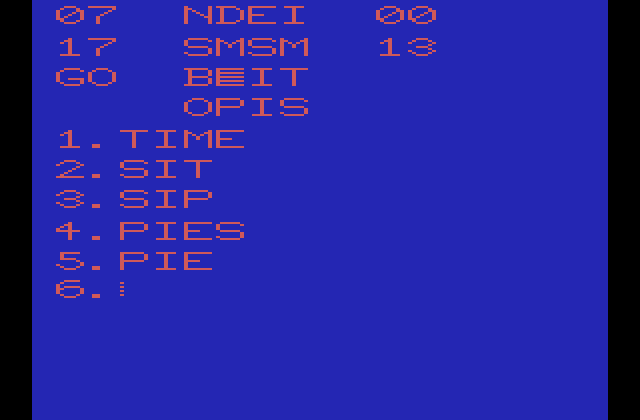
(indicated by the word GO below the players score). Each
player has 99 seconds to form up to eight different words.
Unfortunately due to the limitations of the 2600,
it is unable to check if the word you just selected is an actual
word. This means the player can cheat by simply selecting
random strings of letters and tell the 2600 that it's a word.
However since this game is two players only, your opponent
will more than likely take issue with your creative spelling.
Other issues include only being able to make eight different
words (there is no word limit in the board game) which is most
likely due to the limited screen real estate, and the lack of a
computer opponent. Interestingly, according to David
no computer opponent was ever planned as almost all early 2600
games were two player only and the small ROM space (only 2K) would
have made even a simple AI and dictionary difficult to
implement. The small ROM space also prevented basic spell
checking from being added.
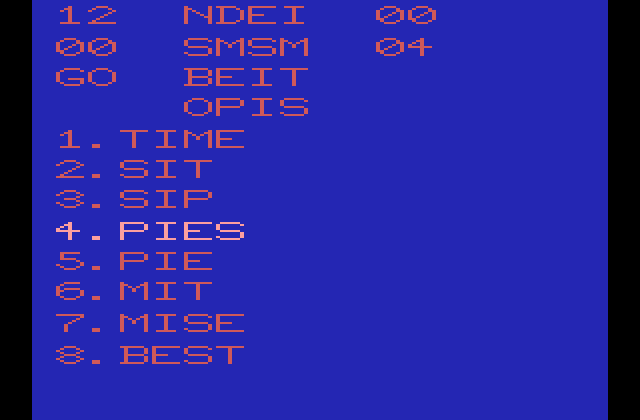
This prototype seems fairly far along, but still
has some issues that need to be addressed. One such bug is
that when the game starts all the letters do not show up on the
screen, it takes a few presses of the reset button to get them all
to appear. Other than some minor bug fixing and polishing
(the game is pretty bare bones), Boggle seems pretty
complete. According to David Crane, Boggle was never got
past the 'working demo' stage due to licensing issues. As
Boggle was a Parker Brothers property, Atari would have had to
license it from them. While this probably wouldn't have been
too difficult, Atari had never tried to license a game before and
didn't see the need for it especially for a game with a limited
audience. Thus Boggle was set aside and quickly
forgotten. By the time Atari started licensing game ideas
with Space Invaders, Boggle was considered too primitive a concept
to revisit (not to mention PB was getting ready to start their own
game development studio). David did try his hand at another
word game after moving to Activision called Cryptogram, but this
also ended up not being released.
| Version |
Cart Text |
Description |
| 8/7/78 |
Boggle 8/7/78 |
Almost Complete |
Return
to 2600 Software
|