|
Glib
The 2600 was no stranger to board game conversions.
Versions of checkers, backgammon, Othello, and even Boggle
had been attempted over the years with mixed results.
However did you know that the 2600 got a port of the blockbuster
word game Scrabble? In 1983 Selchow & Righter (the
company behind Scrabble) decided that the video game market was
hot and they wanted in. But rather than target the world
of home computers, S&R decided to bring Scrabble to the
humble Atari 2600. Of course some changes would have to
made to work within the 2600's limitations and that's where Glib
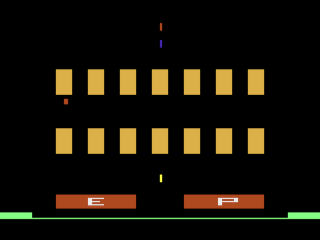
comes in. 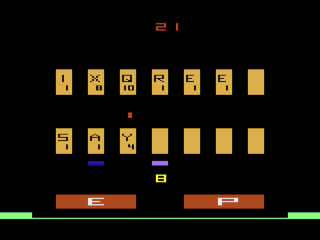 To say that Glib is a port of Scrabble is stretching the definition of the word 'port'. Glib is more of a lite version of Scrabble with the game board removed. Due to the 2600's graphical limitations there was no way a full port of Scrabble could be made, so changes had to made. Glib reduces the game screen to two rows of seven slots (called racks) Enter and Pass buttons, and a time bar at the bottom. The player must form words by moving each of the letters from the top rack to the slots the bottom. The player who has the most points after seven rounds (fourteen in one player games) wins. There are both one and two player modes, but due to the limited amount of memory and cartridge space (the game is only 4K), there is no computer opponent.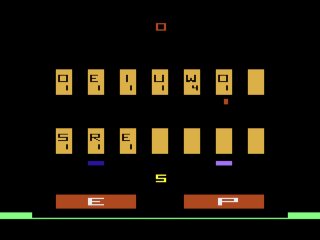 The limited amount of cartridge space leads to
another problem, there is no dictionary for the computer to
compare your word against. If the player wants to put
down QZXV as a word the computer will trust that you know what
you're doing and take it as a legitimate word. To get
around this limitation in two player games the other player
must agree to accept each word as you enter it or it will not
count (in one player games you're free to cheat to your hearts
content). Glib sports five different variations, each
with four different difficulty levels. The skill levels
only affect the amount of time each player has on their turn
(infinite, 132 seconds, 39 seconds, or 24 seconds). The
right switch can be used to double the speed of the time bar
if the player is wants an even harder challenge (B=Normal,
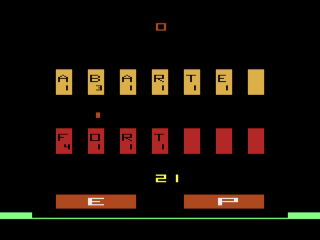
A=Fast). There are also double/triple letter multipliers
(indicated by pink or blue bars under a slot) and
double/triple word multipliers (the entire bottom rack will
turn pink or red).
Billboard - This is your standard mode of play. At the each round all the letters on both the top and bottom racks are cleared out (with a nice little explosion graphic) until all 98 letters have been shown. Skill Builder - This is the same as Billboard
except only the letters on the bottom rack are cleared at the
end of a round. Times Up - In this variation the player tries to make as many words as they can from the letters rather than a single word for points. Encore - This is probably the most interesting variation. Here the letters 'parade' across the top rock and player must 'catch' (select) each letter and use it before it leaves the edge of the screen. If a letter moves off the edge of the screen it will circle around to the other side. Over The Edge - This is the same as Encore
except once the letters leave the screen they don't come back.
The controls for Glib are pretty intuitive but
the placement can be a little tricky for a first timer.
The pointer cursor can be moved between the top rack and the
bottom by pressing up and down on the joystick. At the
start of each round the letters will randomly shuffle, to
start the round the player must push the fire button and a
random letter will be chosen to be moved to the bottom
rack. This may seem a little odd but the letter can be
put back after the player selects a second letter and moves it
down (this was most likely done because the game will not
allow the bottom rack to bet empty). After the initial
shuffling, the player places the cursor under the letter on
the top rack that they wish to use and presses the fire
button. Then the player moves the cursor to the lower
rack and selects the position that they wish to place the
letter in and presses the fire button again. The letter
is then moved from the top rack to the bottom rack and placed
appropriately. Letters are always moved down after they
are placed so there are no empty spaces in between. The
player can then either grab more letters from the top rack or
move them around the bottom rack to form words by selecting a
letter, moving the cursor to where they wish it to go and
pressing the fire button again. Once the player is happy
with their word they can move the cursor down to the large 'E'
square and press the fire button to end their turn (here is
where the second player will have to agree or disagree with
the the word). The player can also move to the large 'P'
square to pass their turn if there are no possible words to
form. 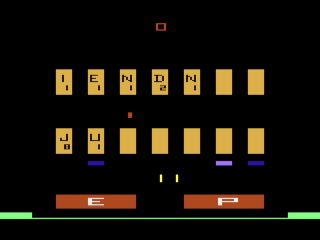
So why is Glib such a rare game?
According to Mike Montana (son of programmer Rich Montana)
there was a scanline bug that made the game screen unstable on
some TVs. The programming documents that Rich had used
were actually for PAL systems which have more scanlines
available for the programmer due to the nature of how the PAL
standard works. This means that the programmer has more
time to run code before the beam returns to the top of the
screen. If the 2600 is still displaying graphics after
the electron beam has returned to the top of the screen the
display gets out of sync and begins to roll. The reason
this wasn't discovered before it was released is because the
timing was technically right on the edge of what would work on
an NTSC TV and some sets handled this better than
others. Due to this bug retailers started returning all
copies of the game and as S&R didn't want to spend more
money on making a corrected batch of cartridges the game was
quietly buried and written off. 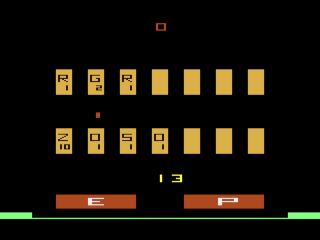 Glib is an interesting example of how everyone
seemed to want to get in on the 2600 market during the height
of the video game boom. While making a Scrabble like
game for the 2600 wasn't a bad idea in theory, limiting the
cartridge to 4K hamstrung what could be done with the
game. With more memory (and more time to test and debug
the game) Glib could have turned out to be a decent little
game. Then again with the video game crash of 83 right
around the corner it may not have mattered anyway.
|