|
Warlords
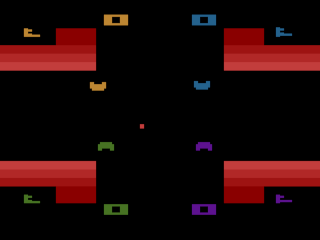
Warlords holds the honor of being one of the few home console games that was ported to the arcades. Originally conceived by artist Roger Hector as an idea for an arcade game, Warlords was actually developed first for the Atari 2600 and then for the arcades after the 2600 version was finished. However in a strange twist of fate, the arcade version of the game ended up being released first in April of 1981 while the Atari 2600 version didn't hit store shelves until a month later in May of 1981. 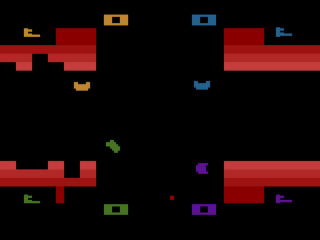 Warlords can best be described as 'four player breakout', but
this description doesn't do the game justice. Each player
has their own castle in one of the four corners of the screen
which is composed of three layers of protective bricks and
inside each castle sits the warlord on their throne.
Outside of each castle is a shield which the player can control
with their paddle controller and can only move along the
perimeter of the castle. The goal of the game is to use
the shield to deflect the fireball so it destroys the other
players castles and eventually hits their warlord. The
last surviving player wins the round and the player who wins
five rounds wins the game. 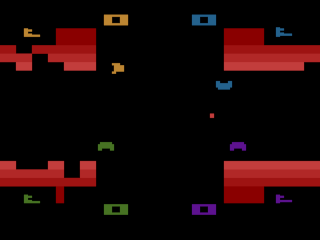 While the concept sounds simple (and truth be told it is),
it's amazingly fun. Being an early Atari game, Warlords is
one of those games that follows Nolan Bushnell's axiom of 'easy
to learn, but hard to master'. Anyone can easily pick up
the game, but to truly Warlords takes time. One of the
things that makes Warlords such a great game is the large amount
of variations but they all boil down to two basic options:
Catch/Ricochet and Lightning Ball/Fireball. 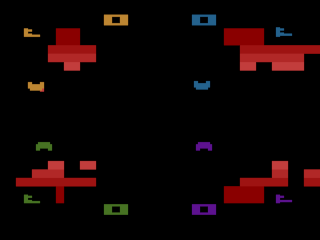 Catch/Ricochet determines whether or not the player can hold
down the fire button to 'catch' the ball when it touches their
paddle (Ricochet means they cannot catch the ball). When
the player catches the ball they can hold it indefinitely on
their paddle until they choose to the release it. The
catch variations add a lot of strategy to the game by allowing
the player to perform lightning quick targeted attacks against a
specific opponent. Lightning Ball/Fireball is a fancy way
of describing the ball speed. Lightning ball means the
ball moves extremely fast while Fireball means it moves
slower. Each of these combinations of options supports one
to four players with the 2600 controlling the unmanned
players. There are also Doubles variations in which each
player controls two sets of shields (the players on the top and
bottom of each half of the screen) which can be fun if you and a
friend want to beat up on each other without the computer
getting in the way. In addition to the above variations
there are also three special 'Children's Variations'.
These variations feature slower gameplay which would be suitable
for younger children and are always set to Ricochet/Fireball. 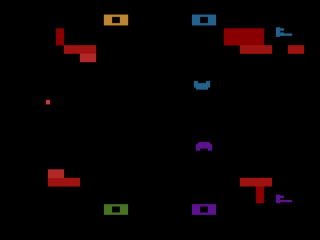
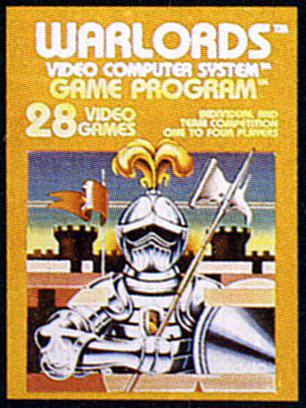
Early catalogs showed different box art that looked more reminiscent of Atari's late 70s cartoons style featuring a knight in armor holding a halberd and a shield. This box also shows that the game had 28 variations instead of the final 23 versions. An early prototype exists that actually does have 28 variations, so this box art must date to around this time (late December of 1980). The final artwork features a likeness of Atari programmer Jim Heuther as the titular warlord. Atari liked Jim's look so much they also used him for the artwork on Backgammon and Othello as well. Prototype Box
|