|
|
Asteroids
|
Name:
|
Asteroids |
|
| Company: |
Atari |
|
Model #:
|
CX-5201 |
|
Programmers:
|
Atari 8-Bit Version: Tod Frye
Atari 5200 Port: Harry Brown?
|
| Year: |
1982 |
|
Released?
|
No
|
Notes:
|
Prototype
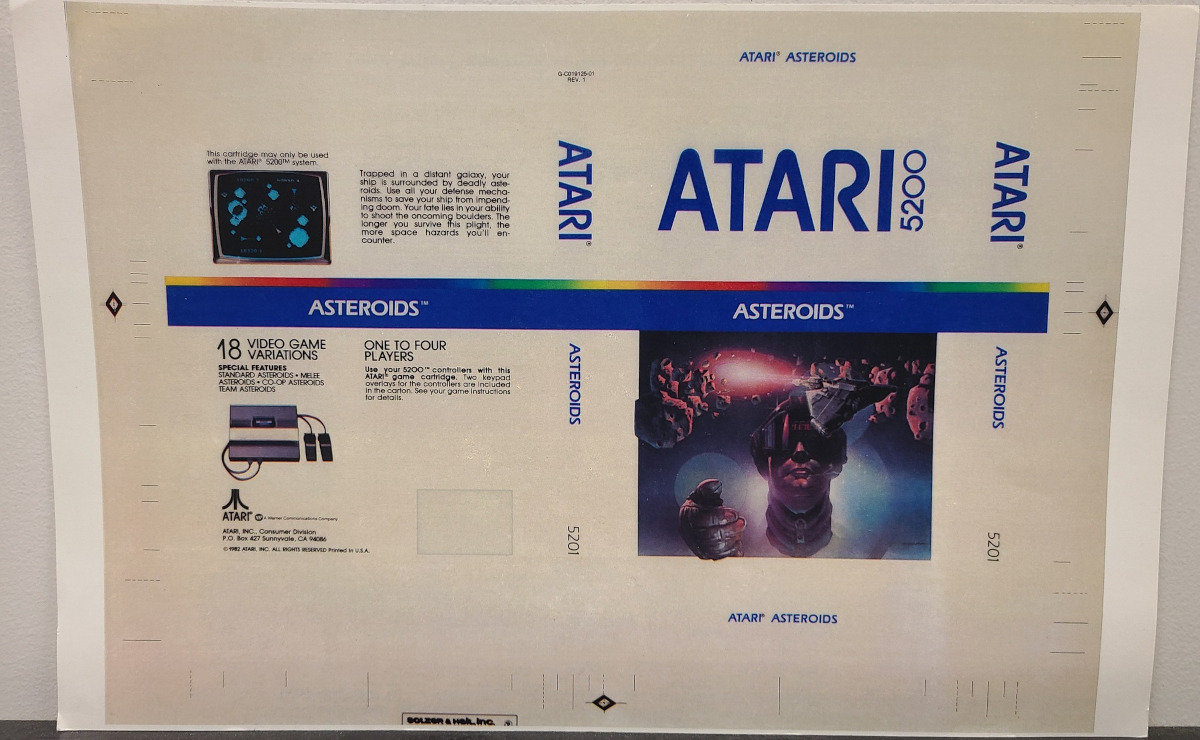
box artwork exists
|
The Atari 5200 version of Asteroids holds a special place in
history as the only launch title never to be released.
That's right, Asteroids part number is CX-5201 and was the
first game planned for the new Atari 5200 system. So why
did it go unreleased? For the answer to this mystery we
have to but examine the 5200 controller...
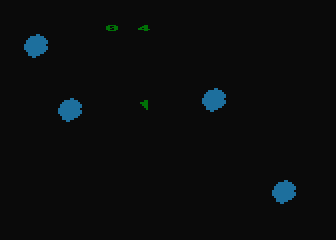
The original Asteroids coin-op didn't use a
joystick at all. All the movement was controlled via buttons
(rotation, thrust, warp, etc.). When Atari converted
Asteroids to the various home systems they had to make a few
adjustments to the control scheme. The standard Atari stick
(the CX-40) which was packed in with the Atari 2600 and 400/800
was an 8-way, self-centering, digital controller. This means
that when you pressed in a direction the system read it as left,
right, up, down, or diagonal no matter how hard you pressed.
The controller also returned to center when the stick was
released. The Atari 5200 on the other hand used a 360
degree, non-centering, analog stick, which is just about the worst
thing you could possibly use for a game like Asteroids. The
problem is mainly with the non-centering part of the stick.
When the player pushed left or right the stick stayed
slightly left or right causing the ship to start spinning out of
control. Once the ship is spinning setting the joystick to
the center again is nearly impossible. Another problem is
with the 360 movement of the stick which often results in the
player accidentally pressing up or down and hyperwarping or
thrusting forward unexpectedly. The programmer of the 5200
port attempted to address this issue by adding some code to
calibrate the X/Y thresholds, but this required the played to push
the joystick in all four directions at the start of the
game. There's no prompt on the screen to do this so it
probably would have been added to the manual. Even with this
calibration code, the controls are sub-optimal at best.
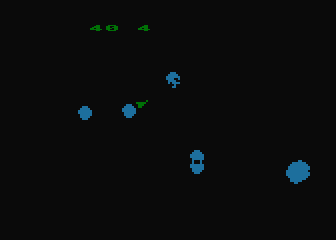
In an attempt to address this problem, Atari
developed a special "Asteroids Controller". This controller
was a large box with several buttons which attempted to mimic the
arcade control setup. While this controller worked quite
well, it was large, bulky, and awkward to use. It is unknown
if Atari was planning on including this controller as a pack-in or
if someone in the lab simply made the controller for their own
personal use. Either way this controller was a unique way to
solve the 5200 controller issue.
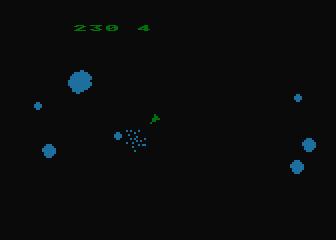
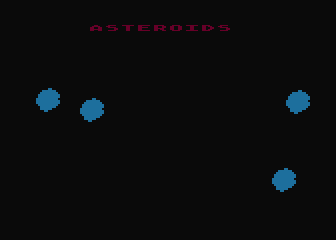
Controller issues aside, the 5200 version of
Asteroids is an adequate conversion with several interesting
options. Like the 2600 version, the 5200 version had to
resort to raster graphics rather than vector. However unlike
the 2600, the 5200 was actually capable of producing vector like
graphics (as was shown with Tempest and Battlezone), but they were
not used in Asteroids for unknown reasons. On the whole the
graphics are average, and show little improvement over the earlier
2600 version. It's obvious that this was a quickie
conversion with little effort involved.
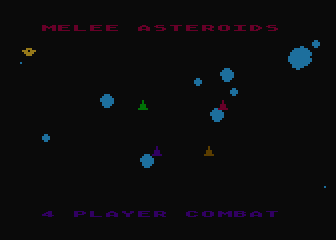
The Atari 8-bit (and unreleased 5200) version of
Asteroids is one of the few games that was capable of supporting
four players simultaneously. This can lead to some
interesting grudge matches. Players can choose from three
different play modes: Melee, Co-op, and Team. In Melee mode,
all the players appear on the screen at once in a sort of
free-for-all. Co-op mode is similar to Melee, but all the
players share a pool of lives. As long as one player as at
least one life left, the game will continue. In Team mode
the players are separated into two teams which compete against
each other. Each play mode has two options available: Patrol
or Combat. In Patrol each players shots travel harmlessly
through the other ships, but in Combat mode players can shoot each
other for points (or just for fun). Players can also choose
several different defensive options such as Shields, Hyperspace,
Flip Over (you turn 180 degrees instantly), or even No Effect (no
defensive options but you gain points quicker). The the
defensive options are triggered by pressing down on the
joystick. Players may also choose Bounce (asteroids bounce
off the edge of the screen) or a Fast/Slow asteroid speed with the
1 and 3 key.
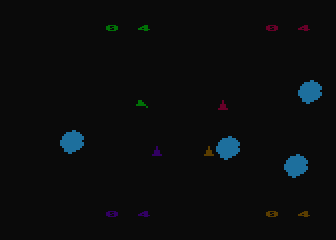
With so many play modes available, the 5200 version
of Asteroids (a direct port of the 400/800 version) isn't a total
loss but could have been much much better. However with the
5200's controller problems this version quickly goes from average
to downright unplayable. Even with a special pack-in
controller one would never get the true four player experience
unless each player bought their own copy (not likely).
Perhaps with some clever coding Atari might have been able
to fix this problem, but it quickly becomes obvious that the 5200
controller was not well suited for this type of game. One
would think that Atari would have figured this out before making
it a launch title. In fact Atari figured this problem out so
late that they had even made a production label and box!
Obviously Asteroids was just about ready to ship before they
put the kibosh on it. Better late than never I suppose...
Asteroids Controller
Production Box and Label
| Version |
Cart Text |
Description |
| 8/12/82 |
Asteroids EPROM Cartridge |
Very Late WIP |
| ?/??/82 |
Asteroids EPROM Cartridge |
Final version |
Return
to 5200 Software
|