|
|
Tempest
|
Name:
|
Tempest |
|
| Company: |
Atari |
|
Model #:
|
CX-5220 |
|
Programmer:
|
Keithen Hayenga (Programmer)
& Michael Kosaka (Graphics) |
| Year: |
1983 |
|
Released?
|
No
|
|
Notes:
|
The box for Tempest
was shown in the move Cloak & Dagger. |
Upon its release in 1980, Tempest took the arcades by storm
(no pun intended). Its mix of fast addictive gameplay and
beautiful color vector graphics (a first for Atari), helped make
Tempest an instant hit. What most people don't know is
that Tempest actually started out as a first person perspective
Space Invaders game. It wasn't until Dave Theurer added
the tubes that Tempest began to resemble the arcade classic we
all know today.
For those of you not familiar with the game, SHAME
ON YOU! If you haven't played Tempest by now then you've
lead a sheltered life. But in fairness to those of you who
may not have been lucky enough to live next to a decent arcade
growing up and since Tempest was never released for any home
system (only 2600 and 5200 prototypes exist), I'll give you the
411
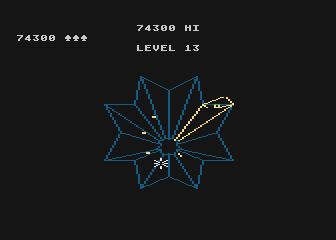
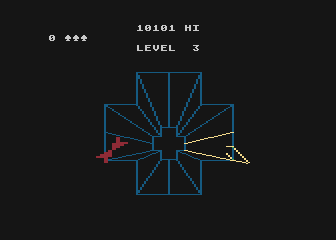
Tempest is a pseudo 3-D game in which the player
moves along the outside of a series of interconnected tubes
while enemies approach from the center of the screen. The
player must shoot these enemies before they climb up to the top
of the tubes. If things get too out of control the player
can use their Super Zapper (one per level) to wipe out all the
enemies on the screen. However there are several different
types of enemies to contend with, and each one has its own
deadly attack.
| Flippers |
These are the most common type of enemy
in the game. As the name suggests these red
triangles flip along the tubes as they make their way to
the top. Once a Flipper makes it to the top of a
tube it will roam along the outside trying to grab the
player. |
| Tankers |
More annoying than deadly, Tankers are
basically two Flippers in one package. Shooting a
Tanker will result in two Flippers springing forth and
moving in opposite directions. |
| Spike Layers |
Spike Layers are devious little
creatures, as they're not deadly themselves. As a
Spike Layer moves up a tube it leaves behind a little
trail known as a Spike. When a player warps after
finishing a level, they must avoid the spikes left
behind in the tubes or be destroyed. Spikes can be
shot back down the tubes (they disappear when they reach
the bottom), but doing so while warping is difficult.
It's best to destroy Spike Layers before they can
lay a Spike or shoot a clear path out before finishing a
level. |
| Fuse Balls |
Fuse Balls are pretty
harmless. They appear as a multicolored ball that
slowly moves up and down the tubes. Make sure you
don't accidentally run into these slow moving creatures
while blazing across the tubes. |
| Pulsars |
Pulsars are the absolute worst enemies in
the game. Pulsars actually electrify the tube
they're on, which will kill you instantly if you happen
to be occupying the same tube. There's a short
delay between when a Pulsar moves onto a tube and when
they electrify it, so use this time to quickly move off.
Thankfully Pulsars aren't encountered until the
higher levels. |
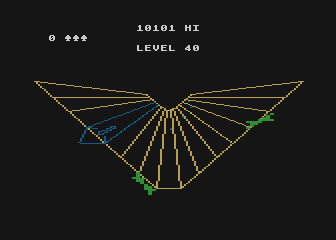
Considered to be one of the holy grails of 5200
prototypes, Tempest was seen in the 1984 movie Cloak &
Dagger as a box on a shelf in the computer store (quick, name
that store). Boxes were also shown for other unreleased
5200 games such as Battlezone and (naturally) Cloak &
Dagger, teasing Atari fans with games that would never be.
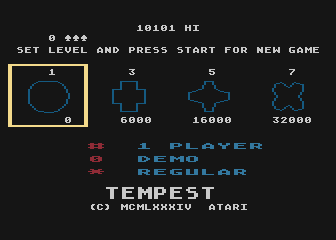
It wasn't until 1998 that Tempest finally surfaced as a 50%
complete prototype thanks to ex-Atari employee Dan Kramer
(inventor of the 5200 trak ball), who had managed to grab a copy
before leaving Atari.
Unfortunately for fans of the games, one of the
things missing from the prototype was collision detection which
made the game virtually unplayable (although the deactivated
code for collision detection was present in the
rom). Also missing from this version were most of the
enemies (only Flippers are present), and the Super Zapper.
Still, 5200 fans rejoiced as one of the holy grails had
finally been found albeit in an incomplete form.
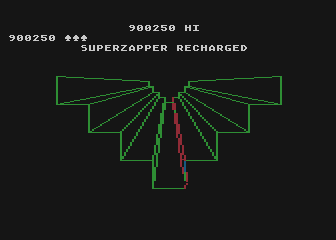
The 5200 version of Tempest was everything that
fans had been hoping for. The vector graphics were
reproduced nearly perfect (a difficult feat for the 5200), the
sounds were flawless as they came straight from the arcade
machine, and the gameplay (aside from the incomplete collision
detection and missing enemies) was perfect. Tempest surely
would have been one of the crown jewels of the 5200's
library. Sadly this was not to be.
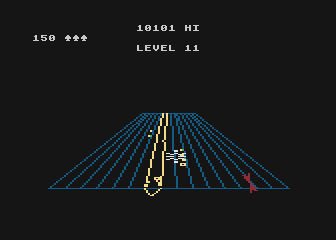
Unfortunately Tempest was still in development
when the video game market crashed in early 1984. It was
around this time that Atari decided to cancel all 5200 game
development and kill off the system. The last known
version of Tempest was still only around 90% finished, but sadly
this version may be lost to the sands of time. However
even in an incomplete state, Tempest clearly shows what the 5200
was capable of if properly programmed. It's truly a shame
that brilliant arcade ports like this didn't make it out the
door.
| Version |
Cart Text |
Description |
| ?/??/83 |
|
Very early level demo |
| 12/29/83 |
Tempest |
1983 Winter CES demo.
Lacks complete collision detection and most
enemies. |
| 3/15/84 |
|
Pulsar demo version |
Return
to 5200 Software
|