|
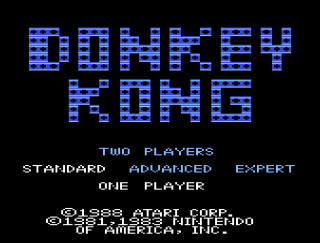
Donkey Kong
Released in 1981, Donkey Kong was a smash hit when it hit the arcade scene. Not only did Donkey Kong introduce us to Mario (then called Jumpman), but helped popularized the platformer genre. Donkey Kong spawned two arcade sequels, an arcade spin off (Mario Bros.), and numerous home games. Donkey Kong was as influential to video game history as Pac-Man helped cement Nintendo as an household name. The home rights to Donkey Kong were a highly sought after prize which was claimed not by Atari, but rather by Coleco for their Colecovision system. So how come Atari was able to produce Donkey Kong for their system? Due to the wording in the contract, Coleco only had the rights for 'consoles' not for computers (this caused problems when Coleco released an upgraded version for the ADAM). Atari bought the home computer rights and released Donkey Kong on their Atari 8-Bit line of computers. They were not however allowed to release it for their consoles such as the 2600 and 5200. By the time the Atari 7800 came around Atari had managed to license the console rights from Nintendo as Coleco was now defunct. 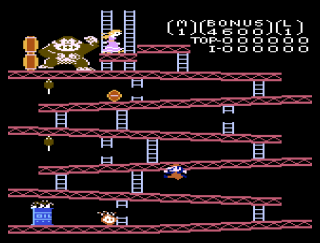 The plot of Donkey Kong is simple. Guide Mario Jumpman up to the top of each level to rescue Princess Peach Pauline from the evil clutches of Donkey Kong Donkey Kong. Each level has its own set of obstacles to avoid ranging from barrels and FireFoxes to... springs? While Mario's only defense is usually to jump over or duck under obstacles, he can occasionally grab a hammer which will allow him to destroy enemies for a limited amount of time. However when Mario has a hammer he is unable to climb ladders so use them with caution. It's also worth noting that Mario is not invincible when using the hammer and a well timed enemy can still bring him down.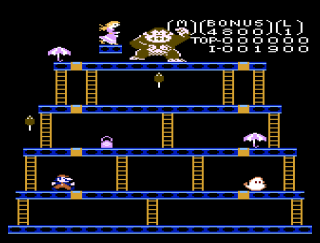 Screen 1: Girders
Once Mario makes it to the top, Donkey Kong will grab Pauline and climb up the ladders (well in the arcade version anyway, here he just laughs at you). Let’s quickly move onto… 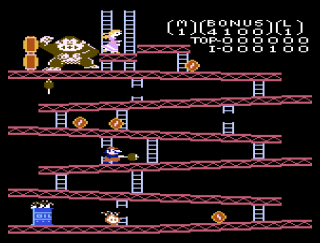 Screen 2: Elevators
Whew, that was intense! Lets continue onward to… 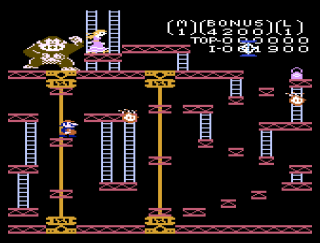 Screen 3: Rivets
Once you undo all eight rivets the girders will collapse
and Donkey Kong will fall on his noggin. Mario can now be
with Pauline forever! Unfortunately you know how arcade
games work, Pauline mysteriously gets captured again (and again,
and again, and again) so Mario must begin his quest anew. The Atari 7800 port of Donkey Kong is decent, but could
have been better. While it looks pretty close to the
arcade and NES versions (which many consider to be the gold
standard for home ports), it's missing some key features such as
the Cement Factory stage and the 'How High Can You Try?' screen
between levels. There's really no excuse for not including
these, but even the NES version was missing the Cement Factory
stage due to space constraints. The gameplay feels a bit
off with Mario being a bit sluggish and the jumping arc not
being quite right, but at least the girders level has the
correct number of girders with Donkey Kong being on the left
side. Not even the highly praised Atari 8-Bit port got
that right. But where the 7800 version really struggles is
in the sound department. Due to the 7800 not having a
dedicated sound chip, it's forced to use the TIA chip that was
included for 2600 compatibility. That means we get 2600
sounds and 'music' throughout the game which in the hands of a
skilled programmer could have been tolerable but unfortunately
this is not the case here. The tinny beeps and boops
really ruin what could have been a decent home conversion. 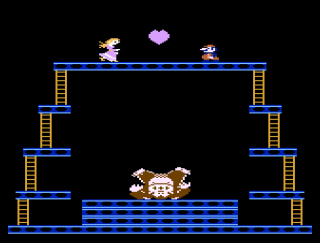
The 7800 version of Donkey Kong (along with Donkey Kong
Jr. and Mario Bros.) was programmed by a small company called
ITDC which may have outsourced their titles to a subsidiary in
Shanghai China called the Shanghai Software Consortium (SSC).
This means that this port was most likely done overseas by
programmers with little to no experience with the 7800 and
without much in the way of tech support. Given this, it's
amazing that this port of Donkey Kong turned out as well as it
did. It's just a shame that by 1988 not many people were
caring about an average port of seven year old arcade game on a
dying system.
|