|
|
MIDI Maze
|
Name:
|
MIDI Maze |
|
| Company: |
Atari |
|
Model #:
|
RX-8124 |
|
Programmer:
|
Michael Park & George Miller
(Xanth F/X) |
| Year: |
1989 |
|
Released?
|
No
|
|
Notes:
|
Prototype Box Artwork exists |
MIDI Maze holds a special place in gaming history as being one
of the earliest (if not the first) first person shooters.
Originally released for the Atari ST in 1987, MIDI Maze
allowed multiple players to fight each other in deathmatch
combat years before Doom became part of the vocabulary of every
gamer.
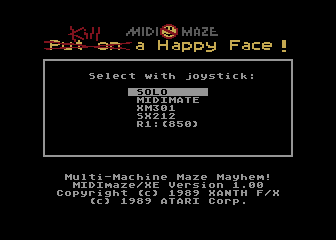
The secret to MIDI Maze was the MIDI interface
(Musical Instrument Digital Interface). This port found on
all Atari ST computers, was normally used by musicians to hook up
keyboards and synthesizers to the computer. However some
clever individuals figured out that it could also be used to
network up to 16 computers together for multiplayer gaming (hence
the name of the game). However since the Atari XE doesn't
have a MIDI port, the programmers implemented several new
networking options including the MIDIMate (a MIDI interface for
the 8-bits), XM301 modem, SX212 modem, and even the Atari 850
interface. This wide array of connection options ensured
that all players would be able to enjoy the network gaming
experience. Players can also play solo vs up to 11-15
computer opponents depending on the maze selected.
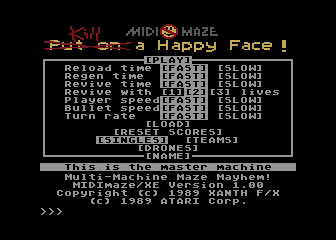
MIDI Maze allows players to chose from a
surprisingly large number of gameplay options for customizing each
map: Reload Time, Regen Time, Number of Lives, Bullet Speed, Turn
Rate, Single or Team Play, and the Number of Drones and their
intelligence (from Very Dumb to Nasty). Players can also put
in a name for themselves (otherwise they're known by a single
letter) and select which maze they would like to try (24 in
all). After choosing the game parameters, players are
presented with some of the finest 3-D graphics to grace the XE.
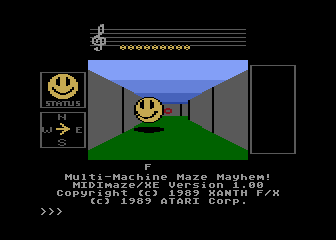
The first thing you will undoubtedly notice is that
the actual game area itself only takes up a third of the screen.
This is due to the massive memory requirements of the game,
and by using only a small portion of the screen the programmers
were able to keep the frame rate incredibly smooth. A
compass to the left helps the player keep his bearings in the
maze, while the smiley display above it shows the players current
health (very similar to the Doom face). To the right is the
players 'kill' count display, which shows how many other players
he has eliminated. Above the screen there is a musical staff
which displays each player's 'kill' count as a sort of graph.
Each player is displayed as a note, and the more 'kills'
each player has, the higher they appear on the scale. This
is an obvious nod to the musical origins of the game, although
ironically due to memory limitations there is no music in the
game. The bottom of the screen displays the chat log between
players (this was years before real time chat became popular).
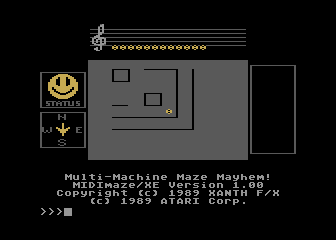
Pressing Tab at any time will bring up a map of the maze.
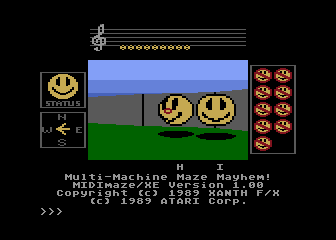
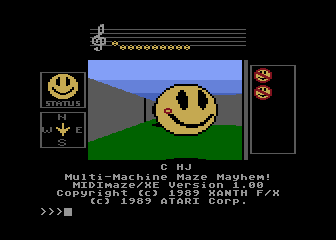
The goal of the game is simple, eliminate everyone
before they eliminate you. Unlike the grisly ultra violent
first person shooters of today, MIDI Maze uses colorful 3-D smiley
faces to represent each of the players. Instead of shooting
guns and lasers at each other, players hunt each other down using
bullets that look like large balls (deadly balls). This
decidedly nonviolent gameplay allows those under the age of 18 to
enjoy the game as well as adults. Even ultra conservative
Nintendo didn't feel the need to censor the game when they ported
the game to the NES as Faceball 2000.
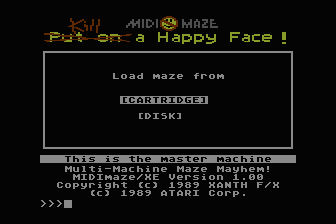
MIDI Maze has a hidden feature that allows the
player to load mazes from a disk instead of using the 24 per-built
ones from the cartridge. To access this feature put a DOS
formatted disk in the disk drive while booting the game, highlight
the LOAD command on the main menu and press START instead of the
fire button. This brings the player to a hidden menu where
the player can load their own mazes from a disk. Although
there's no maze editor players can still create their own by
following a simple format. First the player must create a
ATASCII file that ends in .MAZ. The first line of this file
must contain a two digit number that serves as the mazes
dimensions (all mazes are square) but the size of the maze cannot
exceed 65. Next the player must define the maze layout line
by line using X's for walls and .'s for spaces. There are
only three rules when it comes to the layout, 1. The outer wall
cannot contain any gaps, 2. Walls may only be played on even
coordinates or glitches will occur, and 3. Each line must contain
an EOL character. Interestingly this format is exactly the
same as the original Atari ST version, except the EOL characters
are different. It's unknown why this feature was hidden, but
it may be that there wasn't enough time to test and debug it.
Although MIDI Maze seems complete there is at least
one issue that would need to be ironed out before release.
In the latest two builds of the game there is a great deal of
slowdown when there are too many computer drones in the maze
unless they're set to the lowest AI level. Oddly enough this
slowdown wasn't present in the earliest prototype that is missing
the highest level AI. Even with this issue, MIDI Maze is an
amazing game that pushes the XE hardware to its absolute limits.
It's simply amazing to think that a networked multiplayer
first person shooter was even possible on the Atari 8-bit
hardware, much less one that supports real time chat. It's a
mystery as to why MIDI Maze was never released, but it was most
likely due to Atari killing off its 8-bit line at the time.
The decision to cancel the game must have been made very
late, as preliminary
box artwork had been completed. It's a shame that a
game as amazing as MIDI Maze never saw the light of day, because
it is truly one of the lost gems of the Atari XE.
| Version |
Cart Text |
Description |
| ?/??/89 |
None |
Missing Nasty AI |
| ?/??/89 |
None |
Late Beta
|
| ?/??/91 |
None |
Final Version? |
Return
to 8-Bit Software
|