|
|
Topsy Turvee
|
Name:
|
Topsy Turvee
|
 |
| Company: |
Datamost |
|
Model #:
|
N/a |
|
Programmer:
|
Frank Cohen |
| Year: |
1982
|
|
Released?
|
No
|
Notes:
|
Also called
Topsy-Turvy and Topsee Turvee
|
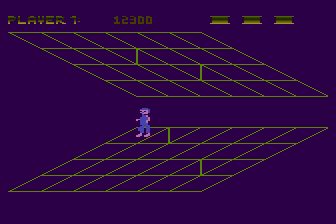
Topsy Turvee (also called Topsy-Turvy in some places), was an
experimental platform game by Frank Cohen. Better known
for games like Cohen's Towers and Scrolls of Abaddon on the
Atari 8-Bit computers, Topsy Turvee was to be Frank's first
attempt at an Atari 5200 game.
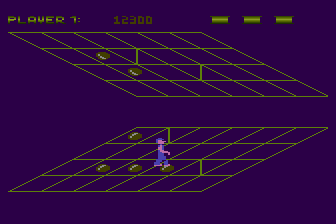
Being a very early demo there isn't much gameplay
implemented. Topsy Turvee bypasses the standard Atari 5200
splash screen and drops the player directly into the game, no
title screen or options have been implemented yet. The game
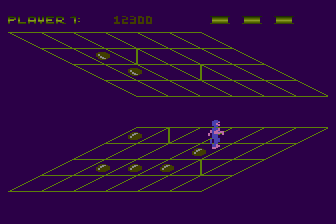
screen shows two 4x6 isometric grids, one on the top of the screen
and one on the bottom. There are two 'chutes' that allows
the player to travel from one grid to the other although oddly the
chutes are in different places on each grid and don't line up with
each other. The player can walk around each of the grids
causing little beads to appear. These beads don't appear to
do anything and once the player has filled both grids with them,
there isn't anything else to do. Sometimes the beads will
appear up in the score area due to the buggy nature of the
demo. The player can also fall off the sides of the grid,
but since they appear to have infinite lives in this demo no life
is subtracted. The score counter is also non-functional and
always shows 12300.
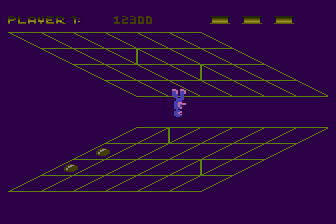
According to Frank the gameplay would have revolved
around the player collecting beads for energy while avoiding
enemies. The 'gimmick' of the game was that it was in 'two
dimensions' with the player having to navigate both the top and
bottom of the screen. Walking off the sides of the grid was
then supposed to move the player to another grid with a different
set of beads to collect with some sort of strategy required to get
from one grid to the other. Unfortunately none of these
ideas have been programmed yet so the player is doomed to simply
walk around a grid full of beads. It's interesting to note
that the final version would have had the player collecting beads
while it appears that in this early demo the player is placing the
beads as he goes.
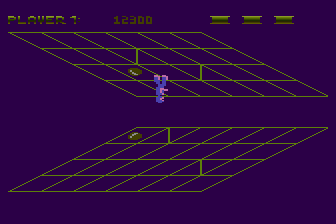
Topsy Turvee was Frank's first attempt at a 5200
game and as such had a number of issues that had to fixed before
it would compile. One of the quirkier things is the joystick
centering code which does not work in emulators using a
keyboard. The reason behind this is due to the fact the game
attempts to calibrate the 5200's analog joystick by having the
player move the joystick to various extremes and using those
values for center. While this works with an analog joystick
it does not function correctly when using keys on a keyboard
(digital input). Frank later refined this centering code for
his next 5200 game attempt Mail Boy. Another quirk of the
joystick code is that the left and right inputs appear to be
reversed! Whether this is the result of a simple programming
bug or was intentionally done for some reason is unknown.
According to Frank work on Topsy Turvee was
abandoned when he couldn't find a publisher that was interested in
it. However a Datamost press release from 1983 mention Topsy
Turvee (listed as Topsee Turvee) as being an upcoming title for
the Atari 8-Bit computers and Commodore 64. A small
blurb describing the C-64 version in the 1983 issue of Commander
Magazine (most likely taken from another press release) states:
"Designed for younger
audiences, this upside-down 3-D perspective computer game features
two-grid action. Your goal is to fill up the grids with what
closely resembles loaves of bread. As you work to fill up
the grids, little creatures try to knock you off the grids into
the holes so that when you re-appear you are playing upside down."
This very much matches the limited gameplay from
the 5200 demo version (minus the creatures) and gives a glimpse
into what the game might have looked like if it had been
finished. It's unknown if any work was done on the Atari
8-Bit or C-64 versions, but the 5200 version never progressed
further than this early demo.
| Version |
Cart Text |
Description |
| 5/8/82 |
|
Early Demo
|
Return
to 5200 Software
|